Meet My Main Character is the historical novelist’s blog hop of the month. Everybody is tagging everybody in a flurry of social networking, akin to some sort of dance. If you’re the new kid in school, a blog hop is the new sock hop; a social exchange in which authors post on their own blogs the answers to a list of preset questions someone poses, then tag other writers to do the same. The exercise is useful to the author as it helps focus aspects of one’s work-in-progress, and it serves to enhance networking among our literary coterie. It also stirs up a little pre-release buzz for upcoming publications.
 Antoine Vanner — author of the Dawlish Chronicles, a series-in-progress set in the Victorian era, often aboard steamships — tagged me first. Antoine’s knowledge of human nature, his passion for nineteenth-century political and military history, and first-hand experience of their locales provide the background for his stories. Antoine portrays lesser known but exciting events and exotic settings for his vibrant novels, Brittania’s Wolf, and Brittania’s Reach. His main man Nicholas Dawlish is a complex character, heroic yet imperfect, a man of his times.
Thank you, Antoine, for your interest in my main character. Who is she? Why would you be interested in what happens to her? Here we go, let’s pop the questions…
What is the name of your character? Is she fictional or a historic person?
Well, you see, a name is not such a simple thing. Not for a woman, it isn’t.
“Who needs surnames?” I said, still muddle-headed. “They’re never our own anyway.”
Rachel’s smile was rueful. “How true. first we’re given our father’s name, then we take our husband’s. Only our given name remains the same. But what shall I call you?
“Patricia.”
Meet Patricia: Born Patricia Kelley, to her chagrin, the illegitimate issue of the profligate Baron Sheldon Hatterby and his Irish indentured servant. Although daddy sent her to England to be raised as gentleman’s daughter (albeit a natural daughter) he didn’t give her his name. Upon his untimely death she rashly steals away aboard a ship bound for Barbados in a brash attempt to claim the Hatterby sugar plantation. When that seems out of the question, Patricia becomes Mrs. MacPherson upon marrying the old Scot, Doctor Aeneas MacPherson, serving as ship surgeon. At that point in her life she’ll do just about anything to survive. After her husband dies she keeps his last name and the tools of his trade, and takes the first name of his nephew, Patrick, along with the dead man’s identity as a ship surgeon’s mate.
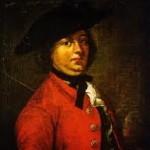
- Hannah Snell, Royal Marine in Captain Graham’s company, Colonel Fraser’s regiment.
While Patricia was born of my imagination, the cross-dressing marine pictured here in the bright red coat was quite real. Hannah Snell was one of dozens, perhaps hundreds of women who chose to portray themselves as men and serve in the navy or the army, in former centuries. More than just a romantic icon, the stuff of ballads and broadsheets, many verifiable incidents of cross-dressing sailors and soldiers have been revealed. Military standards were different then; there were no thorough physical exams like we know today, that would reveal a recruit’s sex. Because young boys often served on ships as servants and apprentices, young women were able to pass themselves off as teenaged boys or young men. Many readers are surprised to learn there really were women who got away with their disguise, living and working alongside men, in some cases for years.
History conveniently forgets many, if not most women – unless they happen to be the wives, lovers or daughters of famous men. Titles such as The Time Traveler’s Wife, The Mapmaker’s Wife, The Bone Setter’s Daughter, The Hangman’s Daughter make me ask why women are so often defined in relationship to men? What about The Time Traveler’s Husband, The Mapmaker’s Ex-Husband, The Bone Setter’s Son, the Hangwoman’s Lover? Why can’t the woman BE the time traveler, the Bone Setter, the Hangwoman? In my series Patricia, posing as Patrick, IS the surgeon’s mate, the adventurer, the seaman. She does not play a passive role or a supportive role. In writing the Patricia MacPherson books I’m exploring what it might have been like to have been a cross-dressing woman in the mid to late 18th century. Why might a woman choose that path? How could she get away with it? What rewards would it bring? At what cost?
The idea came to me while I was serving as a voyage crew member aboard the Bark Endeavour, a working replica of Captain James Cook’s 18th century ship, sailing around the world, training willing sailors to sail the ship. I served on the passage from Vancouver to Hawaii, in 1999. Endeavour was a floating time machine and I was fortunate to spend three weeks aboard, as part of the crew. I’ve also sailed thousands of blue water miles with my husband on a modern sloop; enough sea time to learn how to navigate, steer, and handle sails. My twelve years experience as a nurse in acute care settings have also played a role in imagining Patricia’s life as a surgeon’s mate. Patricia is my own daughter, in a sense, born two centuries before I was.
When and where is the story set?
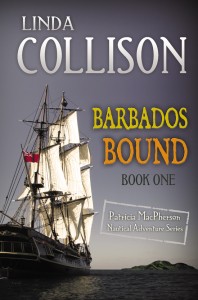
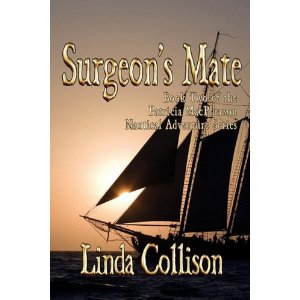
Barbados Bound; Book 1 of the Patricia MacPherson Nautical Adventures begins in 1760, in Portsmouth, England, and ends in Havana in 1762, at the end of the Seven Years War. Surgeon’s Mate, book 2 of the Patricia MacPherson Nautical Adventures, takes place during the following months. Book 3, not yet published, takes place in 1765, during the Stamp Act. Patricia has effectively become a Rhode Island Yankee, passing herself off as Patrick MacPherson on a colonial trading schooner, which she is part owner of. She has an opportunity to make a great deal of profit trading illicitly with Havana, recently given back to the Spanish after the Treaty of Paris. The risk is great but the reward, greater.
 What should we know about your character?
In Barbados Bound, we meet Patricia, a young woman caught between two worlds: That of Britain, a rising world power and Colonial North America. She’s caught between male and female roles. She struggles with dependence and liberty. She presents herself as a man in order to earn a living, as I suspect was the reason most women in precarious positions donned breeches. It was that or prostitution, in many cases.
While Patricia comes to enjoy the freedom of being a man in a man’s world, she is alone. In Surgeon’s Mate; Book 2 of the Patricia MacPherson Nautical Adventure Series she became separated from her lover, Brian Dalton, the gunner aboard HMS Richmond. At the beginning of book 3, she has put Dalton out of her mind. It’s been nearly two years since they parted company.
What is the main conflict? What messes up her life?
Patricia, an adventurer, or smuggler, if you will, must evade Customs, which is now cracking down hard on Colonial merchants carrying sugar and molasses from foreign ports. At the beginning of book 3 Parliament has just implemented the onerous Stamp Act. Riots in New England port towns and the beginnings of organized resistance among the people. British warships are patrolling Colonial waters seizing merchant ships and their cargoes. She will either make a good profit, or lose everything if caught. Another conflict involves matters of the heart when the gunner Brian Dalton, shows up again.
In Havana Patricia meets up with the French Lieutenant who captured her during the war. He suspected she was a female then, and now, in Havana, invites her to join him in his lucrative smuggling ventures, as well as in his bed. Also, in Havana, her services as a surgeon are needed to attend the governor’s daughter in a situation that must be kept secret. The outcome could affect the illicit trade currently allowed to go on.
 What is the personal goal of the character?
Patricia, as Patrick, has been made master and factor of the trading schooner Andromeda for this run from Rhode Island to the Caribbean. If the trip is successful and she evades the Customs officials in Havana and Newport, she will make a tidy sum on her share of the profits. Money means everything to her now; it has become her goal in life, to make enough to be comfortable. She doesn’t dare think too far in the future, because what sort of future can a woman disguised as a man look forward to? A deeper motif is that of finding her true self, sharing her true self with another, and finding a place for herself in the world. A home.
Is there a working title for this novel and can we read more about it?
At first, the working title was “Yankee Moon,” but during the rewrite, the French Lieutenant and Havana took on more importance. I’m now calling it, “Leaving Havana.” If anyone wants to suggest a working title, I’m open! In any case, it will be subtitled Book 3 of the Patricia MacPherson Adventure Series. You can read more about it here on my website, and on Patricia’s Facebook page.
When can we expect the book to be published?
I’m working on the rewrite — and hoping to see an early 2015 publication date.
Thanks to fellow writers:
Antoine Vanner, author of the Dawlish Chronicles. Antoine was my guest blogger recently, on the thread How We Write, with his essay Getting Inside the Victorian Mind.
Debra Brown, author of For the Skylark (and creator of Victorian characters Dante and Evangeline, lovely names both!)
Debra and I co-hosted Aloha Across the Centuries, a recent on-line writer’s retreat in virtual Hawaii
Helen Hollick, prolific author of many historical novels, including the Sea Witch series.
I had the pleasure of meeting Helen in person at the Historical Novel Society Conference 2012 in London, where we joined Margaret Muir, Rick Spilman and David Davies on a nautical historical fiction panel.
Judith Starkston, author of Hand Of Fire, and my guest author blogging about How We Write with her essay, Character Motivation; Love-driven Rage in the Bronze Age.
Margaret Skea, award-winning author of Turn of the Tide, whom I also met at the London HNS. Margaret will be my guest author May 5, blogging about How We Write.
All five tagged me, but Antoine asked first. Sadly, I haven’t been able to tag anyone else. The music has stopped and all seats are taken. The cheese stands alone!