I became interested in the history of hospital ships and shipboard medicine while researching my historical novels, Barbados Bound and Surgeon’s Mate, that take place during Britain’s rise to naval power in the 18th century.  Before that, most battles were seasonal affairs fought close to home; hospital ships were essentially boats used to transport those wounded in battle a short distance back to land.

The 1700s saw the beginnings of far-away wars as European powers began to colonize and wrest economic control from distant lands and seaways.  The Seven Years War (1756-1763) often referred to as the French and Indian War in North America, was the first World War; its conflicts and power struggles were between multiple nations in far flung theaters around the globe.  A threat more deadly than mortar and shot was disease.  Disease killed more soldiers and sailors in the 1700’s and 1800’s than did all the enemies’ weapons combined.  Vessels were assigned temporary hospital duty – especially in tropical latitudes where diseases such as malaria , yellow fever, and other “tropical fevers” were endemic.

Like prison hulks, hospital ships were usually vessels that were no longer suited for the line of battle.  It was cheaper and more efficient to have a floating hospital that could follow the fleet rather than to build and staff land-based hospitals all over the world.  Then too, the air was thought to be more salubrious offshore.  The germ theory of disease had yet to be developed and it wasn’t known that mosquitoes carried the microorganisms that caused many of these tropical fevers.  Many of the ill suffered from scurvy as well – a vitamin C deficiency, as it would later be identified.  Soldiers and seamen too ill or incapacitated to fulfill their duties were sent to hospital ships to recover, thereby relieving the warships of the burden.

The age of steamships meant vessels were no longer at the mercy of the winds.  While their overall speed wasn’t much faster, the speed was consistent and independent of wind direction.  In the late 1800’s as the United States began to embrace steam power and moved from a policy of isolationism to one of imperialism, the outcome was the Spanish American War.  Realizing the success of the Red Rover as a floating hospital (discussed in my previous entry) the U.S. Navy made more extensive use of hospital ships in the war with Spain (Milte Riske, “A History of Hospital Ships.” SEA CLASSICS; March, 1973.)

U.S. President Theodore Roosevelt flexed his muscles, sending a “Great White Fleet” of sixteen battleships on a circumnavigation as a show of U.S. power.  The hospital ship Relief was part of this imperial cruise.  While the fleet was in the Mediterranean it responded to a deadly earthquake in Italy, rescuing many and proving that hospital ships could also be used for humanitarian purposes as well as support for battleships.  Unfortunately, the Relief proved unseaworthy in a Pacific typhoon and was reassigned as a floating dispensary in the Philippines, her name changed to Repose, but other ships were designated as hospitals and played a role in the Spanish American War.

In response to the crisis in Cuba a passenger steamship, S.S. Creole, was purchased by the U.S. Navy, renamed the USS Solace and converted for hospital duties in just sixteen days — thanks in part to a donation from the Red Cross Committee.  The Solace was the first U.S. Navy ship to fly the Geneva Red Cross flag.  Solace was in use during the entire conflict, shuttling wounded Americans back to Norfolk, New York, and Boston.

The Olivette, another American steamer-turned-hospital ship, supported the U.S. invasion of Cuba, receiving wounded Spaniards as well as Americans.  Enemies such as Admiral Cervera, Commandant of the Spanish fleet, along with many of his officers and men.

The steamship Missouri sailed under the British flag before becoming an American hospital ship in the Spanish-American War.  While still in commerce, the Missouri  went to the aid of  the Denmark, an immigrant ship out of Copenhagen bound for New York. The Denmark signaled “Am sinking; take off my people.”  Captain Murell jettisoned his cargo to make space for the rescued passengers and every soul was saved.  Later, this same ship and her crew rescued the steamship Delaware and towed her to Halifax, and towed the foundering Bertha to Barry, England.  The Missouri also carried cargoes of flour and corn to the starving Russians during the famines of 1891 – 1892, after which she was offered to the Surgeon General of the Army by her owner, B.M. Baker, of Baltimore.

“Hospital ships are children of necessity, mothered and fathered by wars,” says Milt Riske in “A History of Hospital Ships.” (Sea Classics, March 1973.  United States Naval Hospital Ships, a Naval Historical Foundation Publication.)  Sadly, that is all too often the case and our country’s shameful actions in the Spanish American War, particularly in the Philippines where we slaughtered so many men, women and children in the name of Imperialism.

In a future post I’ll discuss humanitarian and mercy ships — ships not born of war but of altruism.


According to historian and author  J. David Davies, the concept of a hospital ship was well established in 17th century Britain.  During the Anglo-Dutch wars most casualties were taken ashore in small boats, though several dedicated hospital ships including the Loyal Katherine, the Joseph, the Maryland Merchant, and the Helderenberg were commissioned during the second Anglo-Dutch war.

Yet during those “neighborhood wars” many injured sea men were cared for in private homes in seaport towns.  In Davies’ book Pepys’s Navy; Ships, Men & Warfare 1649-1689, he describes  private citizen Elizabeth Alkin, known as Parliament Joan, who nursed seamen at Portsmouth before 1653, when she moved to Harwich.  She used her own resources for the men’s care, which included Dutch prisoners of war and was partly compensated by the government before she died in 1655.

During Queen Anne’s wars women served on hospital ships, says Christopher Lloyd in The British Seaman.  Suzanne Stark has more to say on the subject in Female Tars; Women aboard ship in the Age of Sail.  In 1696 each of England’s six existing hospital ships was to be assigned six nurses and four laundresses.  They were paid able seamen’s wages. There were continual complaints that the women were drunk and disorderly, but there were also complaints of the male assistants being drunk and disorderly.  According to Stark, hospital ships were usually worn-out sixth-rates or converted merchant vessels.  There was usually only one surgeon aboard, about four suregeon’s mates, six nurses, and four laundresses.

In 1703 Admiral George Byng and Daniel Furzer, surveyor of the navy, recommended that the women nurses be replaced by men.  The navy ruled that women would not be hired to serve in hospital ships, “except when circumstances required.”  Such circumstances quickly developed that same year.  (Incidentally, Admiral George Byng was not the Admiral John Byng who was court-marshaled and put to death in 1757 during the Seven Years War with France  pour encourager les autres – or, failing to do his utmost to prevent Minorca from falling to the enemy.)

I’ve found a few mentions of American vessels serving as temporary hospital ships during the early nineteenth century, the most famous being the ketch, Intrepid. A few months after Stephen Decatur used the Intrepid to sneak into harbor to  destroy the U.S. frigate Philadelphia which had been captured by the Tripolitans, the ketch served briefly as a hospital ship in the Mediterranean.

During the American Civil War the Sanitary Commission and the U.S. Army charterd steamers as makeshift floating hospitals on the Western Rivers.  It wasn’t until December 26, 1862 that the United States Navy commissioned its first hospital ship. The Red Rover was a sidewheel steamship the Union Army captured from the Confederates.  The Illinois Prize Board sold the Red Rover to the Navy   The ship’s first patient as a commissioned hospital ship was a cholera victim.  The medical staff included 30 surgeons and male nurses, and four female nurses; sisters of the Order of the Holy Cross.  They were joined later by several other nuns and some black female nurses.  When a naval hospital was built in Memphis, Tennessee, the Red Rover was relieved of some of her duties and she was removed from the service November 17, 1865.

Nurse working on Red Rover h59652

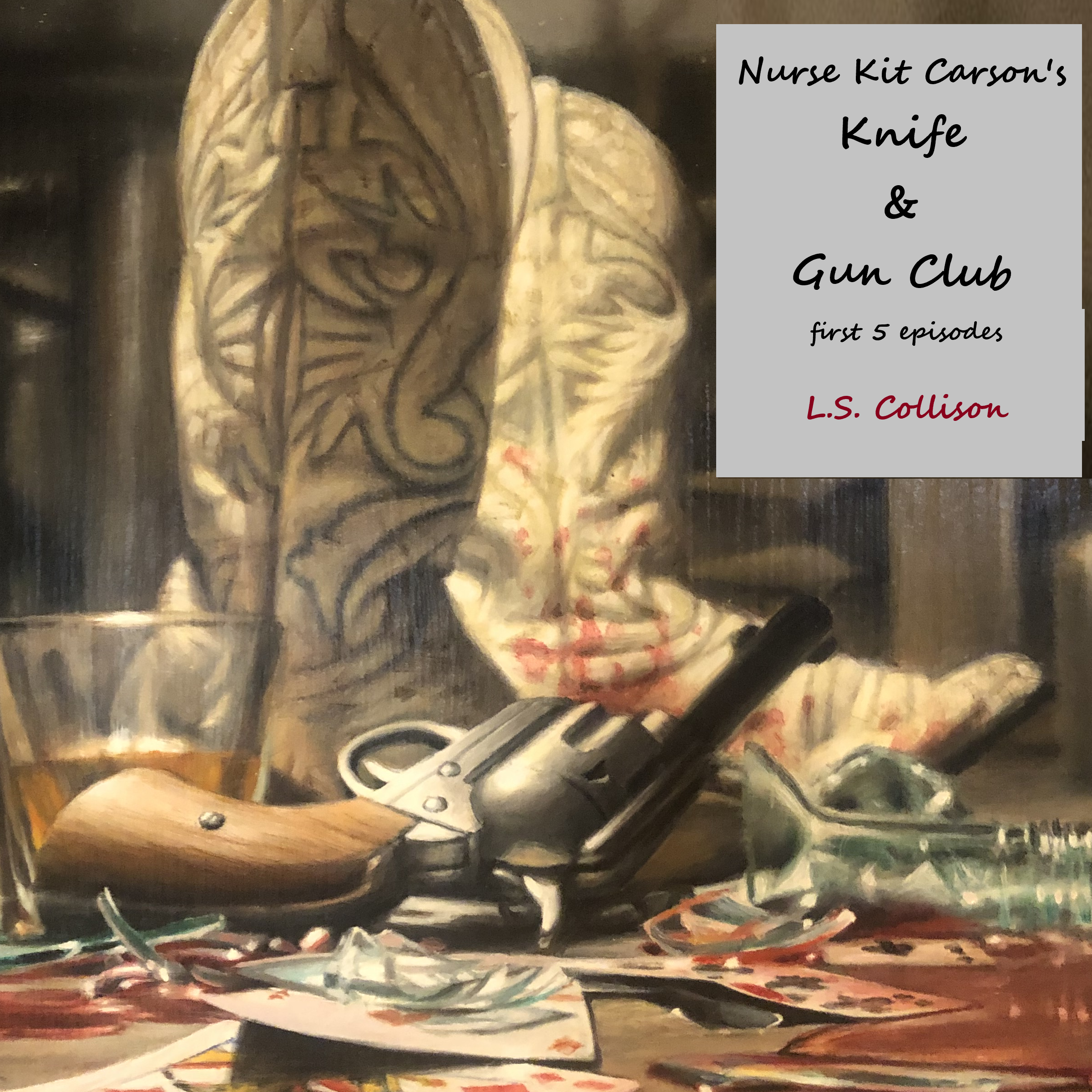
 I love this cover art created by graphic designer and re-enactor Albert Roberts.  He’s totally captured the kitch and the drama I had in mind for the cover art for my new short story, just published on Kindle.  I’m having the cover art made into a poster to hang on my wall to inspire me to finish the collection of short stories and speculative memoir about nurses that I’ve been working on for, well, decades.

The nurses in Friday Night Knife and Gun Club aren’t ordinary nurses.  They live and work in a dystopian near-future, in an unnamed city in the American West (actually, it’s Denver, where I lived and worked for many years) where nearly everybody carries a gun to protect themselves from the loonies.  Yep — it’s the wild Wild West.  And yes, my tongue is in my cheek.

There’s nothing nautical about this story.  And although it’s fiction, I didn’t have to make very much up.  A lot of it comes from my own life.

I was compelled to write it after the shooting that took place at a hospital in Alabama in December.  Which took place just after the Sandy Hook Elementary School shooting in Connecticut, which took place after a random mall shooting in Oregon, which took place a few months after the theater shooting in Colorado.  Not to mention the Gabby Giffords shooting in Arizona, the Columbine school shooting in Colorado, the Virginia Tech shooting… and the beat goes on. And on.  And on.

I am not against guns.  I am against the easy availability of firearms and large magazines.  I am against the idea that the way to fight violence is with more violence.  All those years I worked in the hospital — in emergency and ICU and psychiatrics and oncology — I sometimes thought about what would happen if some angry sociopath came in with a gun and started shooting us up.   In this dystopian short story I’ve re-imagined that horror.  But I’ve given it an ironic twist.  I’ve given the nurses guns.  It’s lurid drama, it’s urban fiction, yet it’s all too real.

Friday Night Knife and Gun Club is available on Kindle for 99 cents — and I’m offering it free this week.  I’m hoping to have the entire collection of short stories completed by the end of 2013 and ready for publication, both in print and electronic format.  Meanwhile, I hope you’ll find this short piece provocative.